
"northern Haiti coffee"
400 article(s) found

A brief introduction to the cultivation of bright sour boutique coffee beans in Dominica, geographical location, climate and altitude
The Dominican Republic has also experienced a history of unrest and poverty, and now the country has implemented democratic elections and entered a period of stable development, but it has not yet formally established diplomatic relations with China, but has maintained so-called diplomatic relations with Taiwan. It seems that this has nothing to do with coffee, but in fact, it still has an impact. The exchanges between the two countries that have not established diplomatic relations are subject to many restrictions in all aspects, and of course they will.

Planting situation of excellent acidity boutique coffee beans in Dominica A brief introduction to geographical location, climate and altitude
The Dominican Republic has also experienced a history of unrest and poverty, and now the country has implemented democratic elections and entered a period of stable development, but it has not yet formally established diplomatic relations with China, but has maintained so-called diplomatic relations with Taiwan. It seems that this has nothing to do with coffee, but in fact, it still has an impact. The exchanges between the two countries that have not established diplomatic relations are subject to many restrictions in all aspects, and of course they will.

Flavor and taste characteristics of coffee manor in Dominica Coffee Bean introduction to Santo Domingo Coffee
After Santo Domingo returned to Spanish rule, the local people gradually formed a consensus on independent statehood. On November 30th, 1821, the former Governor of Santo Domingo, General Jos Nez de Cceres, proclaimed the founding of the country, named Haiti, Spain, and expected to merge under the Greater Colombian State led by President Bolivar of South America. [3] but in February 1822, nine weeks later, Haiti's

Dominican Santo Domingo coffee with rich aroma and rich taste
In 1795, France and Spain signed the Treaty of Basel in Switzerland, agreeing to cede the Santo Domingo area east of the Spanish Dominican island to France, making the Spanish island a complete French colony. Six years later, Toussaint Louverture, a black Haiti, led other black slaves in a revolt against French rule, and in 1801 captured Santo Domingo, which had just been ruled by France

Introduction to the description of Manor Flavor by the treatment method of the Grinding degree of Dominican Coffee
L'Or é al arrived in Santo Domingo in 1801. He abolished slavery on behalf of the French government. In 1802, Napoleon sent troops to conquer the whole island and ruled for several months. In October 1802, mixed-race and black people revolted against French rule and repelled the French army in 1803. On January 1, 1804, the rebels declared Santo Domingo independent and established the Republic of Haiti. But be defeated.

Introduction to the flavor and taste of Dominica Santo Domingo coffee manor
In 1586, Captain Drake of England led a fleet to attack the city of Santo Domingo, but was repulsed by Spanish troops stationed there. Between 1605 and 1606, towns on the west coast of Hispaniola were often plundered by pirates, causing most of the local population to move inland. [3] at the beginning of the 17th century, French, Dutch and British pirates were operating in the west of Hispaniola, and France began to let farmers

Introduction to the characteristics of high-quality coffee beans in Dominica Santo Domingo coffee flavor and taste varieties
In 1677, about 4,000 French lived in 11 villages in the west of the island. In 1697, France and Spain ceded the western part of the island to France according to the Leswick Treaty of the Alliance War, formally recognizing French sovereignty over Haiti in the western part of the Spanish island, and the eastern part of the Spanish island was called East Santo Domingo. France continues to develop its agricultural economy on the island of Hispaniola.

Introduction to the characteristics of Dominican Santo Domingo Coffee Flavor Manor with rich aroma and mellow taste
After Santo Domingo returned to Spanish rule, the local people gradually formed a consensus on independent statehood. On November 30th, 1821, the former Governor of Santo Domingo, General Jos Nez de Cceres, proclaimed the founding of the country, named Haiti, Spain, and expected to merge under the Greater Colombian State led by President Bolivar of South America. [3] but in February 1822, nine weeks later, Haiti's

Flavor description of Dominican coffee with mellow taste introduction to the characteristics of the taste of grinding degree
In 1677, about 4,000 French lived in 11 villages in the west of the island. In 1697, France and Spain ceded the western part of the island to France according to the Leswick Treaty of the Alliance War, formally recognizing French sovereignty over Haiti in the western part of the Spanish island, and the eastern part of the Spanish island was called East Santo Domingo. France continues to develop its agricultural economy on the island of Hispaniola.

Introduction of boutique coffee beans in Dominica Santo Domingo coffee producing area
The earliest coffee in Dominica was introduced from Martinique (the overseas province of France), dating back to the early 18th century. Dominica is an island country with a tropical climate. The temperature changes little throughout the year. Except for the lower temperature in the Central Cordillera Mountains, which can reach less than 0 ℃ in winter, the annual average temperature in other areas is between 25 and 30 ℃, which is affected by the mountain topography.

Dominica coffee with rich aroma and mellow taste the characteristics of boutique coffee in manor area
In 1677, about 4,000 French lived in 11 villages in the west of the island. In 1697, France and Spain ceded the western part of the island to France according to the Leswick Treaty of the Alliance War, formally recognizing French sovereignty over Haiti in the western part of the Spanish island, and the eastern part of the Spanish island was called East Santo Domingo. France continues to develop its agricultural economy on the island of Hispaniola.

Description of Dominica Coffee Flavor with mellow taste A brief introduction to the characteristics of the varieties of Grinding degree
In 1677, about 4,000 French lived in 11 villages in the west of the island. In 1697, France and Spain ceded the western part of the island to France according to the Leswick Treaty of the Alliance War, formally recognizing French sovereignty over Haiti in the western part of the Spanish island, and the eastern part of the Spanish island was called East Santo Domingo. France continues to develop its agricultural economy on the island of Hispaniola.

Introduction of Flavor characteristics of Fine Coffee beans in Dominica Santo Domingo Coffee Variety producing area
In 1677, about 4,000 French lived in 11 villages in the west of the island. In 1697, France and Spain ceded the western part of the island to France according to the Leswick Treaty of the Alliance War, formally recognizing French sovereignty over Haiti in the western part of the Spanish island, and the eastern part of the Spanish island was called East Santo Domingo. France continues to develop its agricultural economy on the island of Hispaniola.

Introduction to the fresh and elegant growing environment of Dominican boutique coffee beans
In 1677, about 4,000 French lived in 11 villages in the west of the island. In 1697, France and Spain ceded the western part of the island to France according to the Leswick Treaty of the Alliance War, formally recognizing French sovereignty over Haiti in the western part of the Spanish island, and the eastern part of the Spanish island was called East Santo Domingo. France continues to develop its agricultural economy on the island of Hispaniola.

Mellow taste of Dominican coffee the characteristics of the manor producing area introduce Dominica coffee beans
Coffee in Dominica is grown in highlands and lowlands, and its taste is slightly different. The upland is sour, but the taste is rich; the lowland is less sour and tastes smoother. Boutique coffee has become popular in recent years. High-quality coffee beans produced by some Dominican estates have a rich aroma, mellow taste and moderately bright sour taste, and have been bought with the more famous Puerto Rico beans or teeth.

Description of Dominica Coffee Flavor with pleasant fragrance introduction of boutique coffee beans in producing areas
The earliest coffee in Dominica was introduced from Martinique (the overseas province of France), dating back to the early 18th century. Dominica is an island country with a tropical climate. The temperature changes little throughout the year. Except for the lower temperature in the Central Cordillera Mountains, which can reach less than 0 ℃ in winter, the annual average temperature in other areas is between 25 and 30 ℃, which is affected by the mountain topography.
Introduction to the characteristics of Dominican coffee beans
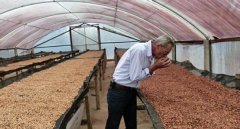
Unlike the coffee produced in Haiti, most of the coffee grown in the Dominican Republic has been washed, which is also a symbol of high quality. Miniga Coffee uses a washing method to treat coffee beans, so that the quality of treated coffee beans is more guaranteed. The coffee beans treated by washing method retain more original flavor than the drying method, and the aroma is pure and soft. "Dominica Coffee beans | Santo Domingo (S
A brief introduction to the flavor, taste and aroma characteristics of Santo Domingo boutique coffee beans with intertwined aftertaste
The selection of Dominican coffee is usually done manually. The main basis for selection is according to the fullness of coffee particles, whether it is uniform, and then grade it. Generally speaking, coffee with full and uniform grains is easier to preserve. Only the fullest and most evenly grained coffee beans can be roasted to represent the best and finest coffee in the country. Unlike coffee produced in Haiti, Domi

Faint aroma of Dominica Santo Domingo Coffee introduction to boutique coffee
The earliest coffee in Dominica was introduced from Martinique (the overseas province of France), dating back to the early 18th century. Dominica is an island country with a tropical climate. The temperature changes little throughout the year. Except for the lower temperature in the Central Cordillera Mountains, which can reach less than 0 ℃ in winter, the annual average temperature in other areas is between 25 and 30 ℃, which is affected by the mountain topography.

Characteristics of Dominica coffee beans in Dominica coffee producing areas
The Dominican Republic is a popular country for travelers. It lives next to Haiti on the island of Hispaniola in the West Indies, Dominica in the west and Haiti in the east. The whitest and softest white sand in the world, the cool sea breeze from the Atlantic and Caribbean and the warm sunshine in the tropics make it a holiday paradise on a par with Maldives and Hawaii.